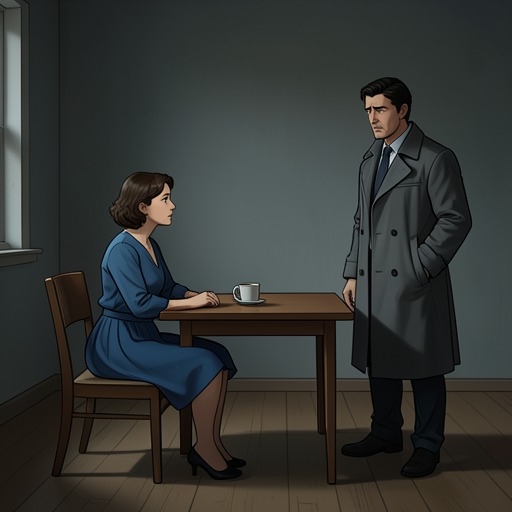
Helen’s post-divorce emotional recovery
Happiness for BeginnersHelen Carpenter’s post-divorce emotional recovery is shaped by a painful contradiction: she knows that leaving Mike was right, yet spends the following year feeling hollow, lonely, and unsure how to become someone beyond the wreckage of the marriage. The wilderness course is her chosen attempt at self-reinvention, but its deeper test is not simply physical endurance. Helen must confront the habits of self-doubt and relational hurt that survive after the person who caused them is gone.
The loss behind the divorce
Helen’s marriage ends in the immediate shadow of a miscarriage. At thirteen weeks pregnant, she went to a checkup expecting to bring home ultrasound images; instead, she learned that she had lost the pregnancy. Her doctor sent her home with warnings about the cramping to come and instructions to find someone to bring tea and hot-water bottles. Mike should have been there for the appointment and the hours afterward. He had forgotten to show up.
That evening, Helen began miscarrying in earnest. Mike, meanwhile, had been drinking at a business lunch, continued drinking with coworkers, and returned home late, after she had fallen asleep. The next morning she woke him and ended the marriage, making the decision in roughly ten minutes, without the tears or regret that would come later. Mike was too hungover and humbled to argue; he kept his eyes down and nodded. Once they separated, Helen did not seriously consider asking him to return. Though she was devastated, she remained certain that life without him was preferable to life with him.
The certainty of the decision did not make its emotional consequences simple. When she later recounts the divorce, she acknowledges that she withheld the miscarriage from her first account of the separation. She dates the divorce to about a year earlier, almost to the day, and says she is fine now, with a qualification that undercuts the assurance. Asked how she is managing being single, she answers that she is fine and great, then recognizes that single does not describe her experience: she feels alone. Her insistence that she is always okay functions less as evidence of recovery than as a practiced way of concealing how much remains unsettled.
A year of shock and an attempt at reinvention
Helen describes the year after the separation as alternating between panic and numbness. The panic carried the what-ifs of giving up on her life; the numb intervals felt like shock filling every available space. Her most vivid image of that period is not a dramatic confrontation but an ordinary grocery-store trip: alone beneath fluorescent lights, with Muzak overhead and a squeaky-wheeled cart full of Campbell’s soup. The small, bleak scene gives physical form to her isolation and to the comfort food she reached for when comfort itself was scarce.
She does not undertake the BCSC survival course because she believes she has already recovered. She goes because she wants to become someone different from the person she has been since the marriage. She had once planned to travel to Paris, but after Duncan told her about the course, she exchanged that plan for what she hoped would be wisdom from the wilderness. She wants a deeper spiritual connection to nature and to push beyond her physical and emotional limits. The choice is deliberately ambitious: Helen wants to do something wild and brave enough to astonish her, even though she is not sure why survival training became her answer.
The written goals make that ambition concrete. Helen records them on old college notecards bearing the name Helen Carpenter, her restored name after the divorce. Reclaiming it is one of the few parts of the separation that already feels good to her. Yet the list also exposes how much she expects achievement to repair. She wants a BCSC Certificate not merely as a record of competence but as a slip of paper that might finally prove she is okay. She is tired of feeling like a disaster and of being trampled on; she wants to be tough, capable, and, ultimately, somebody other than herself. The wilderness becomes both a practical challenge and a wager that a sufficiently impressive accomplishment can certify her worth.
Intimacy, withdrawal, and old expectations
The journey also brings Helen’s unresolved relationship patterns into focus. After a painful turn with Jake, she interprets his behavior through a rule learned in her marriage: he seems to want her when she cannot be had, then to retreat once she lets herself be caught. She connects this pursuit-and-withdrawal pattern to Mike, whom she remembers as most interested when she was angry, distracted, or busy. Over time, she had grown tired of running and wanted instead to be caught. Her disappointment with Jake therefore touches more than the immediate encounter; it revives the fear that closeness will be followed by rejection.
The morning after she believes Jake has withdrawn, Helen turns that experience against herself. She wonders whether she is overwhelming, too emotional, or too needy, and considers whether she attracts men who want too little. She had hoped the trip would help her become a better version of herself, but finds her attention narrowing into anxious questions about whether Jake likes her. Her effort to pursue a larger purpose is interrupted by a familiar desire for reassurance. When Jake later says goodbye and leaves the car, they become strangers again. At the course check-in he maintains an anonymous distance, and at the orientation meeting he sits at the front while she stays near the back. Their separation reinforces her sense that emotional risk has brought no dependable closeness.
Belonging in the wilderness
Helen’s loneliness is not confined to romance. At orientation she feels out of place among the mostly college-age participants, whose matching styles and youth make the age and identity gap conspicuous to her. As the course continues, the group develops nicknames for nearly everyone: the Sisters become Uno and Dosie; Mason becomes Flash; Hugh becomes Huey Lewis. Helen, by contrast, is still sometimes called Ellen because people do not get her name right. She sees nicknames as signs that a person has been noticed and recognized, so her lack of one sharpens the sense that she remains peripheral and could disappear without anyone noticing.
The course nonetheless puts her in situations where other people’s judgment can differ from her own. Before the independent hikes, Beckett explains that he paired her with Jake because she is accident-prone and he trusts Jake as the medic, because Helen is the strongest map reader and Jake is nearly blind, and because she rarely believes in herself while Jake finds a way to believe in her. Beckett’s arrangement turns her perceived weakness and competence into a shared responsibility. Helen receives the pairing not as a simple affirmation but as an assignment to be grateful for the opportunity, a reminder that accepting support is itself part of the work.
Other acts of practical cooperation make the group’s survival depend on more than individual toughness. When Hugh is injured and must be evacuated, Beckett sends people away to prepare for the evacuation, empties three externally framed packs, redistributes their contents, and dismantles the frames to make a litter. The improvised stretcher gives the expedition a concrete counterpoint to Helen’s earlier desire to prove herself alone: in the wilderness, competence includes reorganizing the group around someone else’s need.
Recognition, gratitude, and an unfinished future
By the course’s last morning, the group’s farewell to the wilderness has become a ritual Helen would once have regarded skeptically. They make coffee, pack, and break camp; at sunrise Beckett calls for a minute of silence and then leads a farewell prayer that names human ingratitude and the beauty people fail to notice. Helen begins to clap, and the others join her. Her response marks a change in how she receives Beckett and the group: what might once have seemed ridiculous now moves her to participate rather than hold herself apart.
The course’s Certificates of Merit likewise redefine achievement as something witnessed by other people. Beckett says the awards are based not on being the strongest but on giving one’s best effort, paying attention, and making the trip better through one’s presence; the participants have chosen their candidates by secret ballot. That standard differs from Helen’s private wish for a document that can prove she is okay. The emphasis falls instead on effort, attention, and what a person contributes to a shared experience. The evidence establishes the award criteria and the group vote, not the result for Helen, so the significance lies in the changed terms of recognition rather than in an assumed prize.
Jake’s disclosure of his inherited, incurable vision disorder brings Helen face to face with another person’s future being abruptly narrowed. He tells her that his sight will eventually go dark and that, after searching through the available information, he can do nothing but wait. His father still calls him Doc and sees the high-achieving doctor he had always intended his son to become, while Jake’s own list of desires includes revisiting his childhood home, seeing family photographs in Texas, scuba diving, driving a race car, and riding a frightening roller coaster. Later, he explains that the diagnosis had seemed to erase his plans to become a doctor, have children, and learn to scuba dive. Helen’s response is one of attention to what he faces, not a claim that his losses can be solved.
When Jake finally says that he came to tell her the truth and that he cannot make himself leave her alone, his confession opens a new possibility but does not retroactively erase Helen’s grief or guarantee that it has ended. Her recovery remains a process rather than a certificate: she has acted on the certainty that leaving Mike was right, begun testing the limits she once feared, and encountered companionship and recognition in the wilderness, yet loneliness and self-doubt still shape her interpretations. The movement is not from damage to untouched happiness, but toward a more honest distinction between being alone, being supported, and believing that her life can still contain a future.